

What Is a Uni-Body Hydraulic Breaker? Inside the OKADA UX Series
If you run a mini-excavator, skid steer, or compact track loader, the breaker on the front of it does some of the hardest work in your fleet. The OKADA UX Series is built around a different idea: a uni-body hydraulic breaker, where the cylinder and front cap are one integrated piece instead of several parts held together with side rods. Here's what that means, why it matters on the job, and how to tell if a UX breaker fits your machine.

How a conventional hydraulic breaker is built
Most hydraulic breakers are assemblies. A cylinder, a front cap, and an outer housing are bolted together with long side rods (also called tie rods), with buffers in between to absorb shock.
That design works, but every joint is a place where something can loosen, wear, or fail. Side rods have to be checked and re-torqued. Buffers wear out. The housing adds weight that the carrier has to hold up at the end of the boom all day.

What makes a uni-body hydraulic breaker different
The UX Series takes those joints out. The cylinder and front cap are integrated into a single uni-body structure, so there are:
No side rods
No separate housing
No buffers
Fewer separate parts means fewer failure points. OKADA's engineering puts the UX Series at roughly 36% fewer parts than conventional breakers, which also means lower failure rates and lower operating costs over the life of the attachment.
Lighter on the boom, easier on the carrier
Taking out the side rods and housing also takes out weight. The UX Series is about 10% lighter than comparable models.
On a compact machine, that weight matters:
Better balance. A lighter breaker sits better on a small excavator or loader, which helps stability and control.
Better fuel efficiency. Less weight at the end of the arm means less work for the carrier.
Better fit for tight spaces. The UX Series was designed for small excavators and jobs like corner construction and indoor remodeling, where a bulky breaker gets in the way.
Uni-body hydraulic breaker maintenance, made simpler
Fewer parts means less to inspect, less to stock, and shorter service time. Two design choices make the biggest difference in the shop and in the field.
A one-piece slip-fit bushing
The UX Series uses an integrated front cap and shank bushing in one piece. Because it's a slip-fit design, it can be replaced on-site without special tools and without the time-consuming welding needed to shrink-fit a bushing. It also takes the guesswork out of wear checks: there's one bushing to inspect instead of two.
A serviceable cylinder liner
Inside the body, a replaceable cylinder liner protects the cylinder. If the piston scores, the fix is a liner-only replacement, not a new cylinder. That keeps repair costs down and gets the machine back to work sooner.
Built-in technology on every UX breaker
Every model in the UX Series uses a hybrid power system (gas plus hydraulic) and an internal control valve, giving an efficient oil path and consistent blow energy across the operating range.
The UX40, UX60, and UX70 (the 4 to 7 metric ton class) add:
Anti-Blank Firing (ABF), standard. An on/off adjuster helps protect the breaker when the tool isn't loaded against material. Fully tighten the adjuster for off; loosen it three turns for on.
Auto-lube and underwater ports, standard. The hydraulic auto-lube kit with protector cover and the underwater kit are available as options.
Optional hose protector cover to shield hydraulic lines from debris.
Five UX models, from 1.2 to 9 metric tons
The UX Series covers mini-excavators, compact utility loaders, skid steers, and compact track loaders from roughly 1.2 to 9 metric tons (2,600 to 19,800 lb).
Model | Impact energy class | Carrier weight | Operating weight | Oil flow |
UX20 | 225 ft-lb | 1.2–3.0 t (2,600–6,600 lb) | 293 lb | 5.3–10.6 gpm |
UX30 | 350 ft-lb | 2.5–4.5 t (5,500–9,900 lb) | 383 lb | 6.6–13.2 gpm |
UX40 | 475 ft-lb | 3.0–5.5 t (6,600–12,100 lb) | 471 lb | 7.9–15.9 gpm |
UX60 | 750 ft-lb | 4.0–7.0 t (8,800–15,400 lb) | 626 lb | 10.6–18.5 gpm |
UX70 | 1,000 ft-lb | 6.0–9.0 t (13,200–19,800 lb) | 773 lb | 13.2–23.8 gpm |
Operating weight includes the complete breaker assembly with upper mounting bracket. Specifications are subject to change without prior notice. See the full specifications, including pressure, frequency, and tool diameter, on the UX Series page.
Excavator or skid steer: one breaker, two mounts
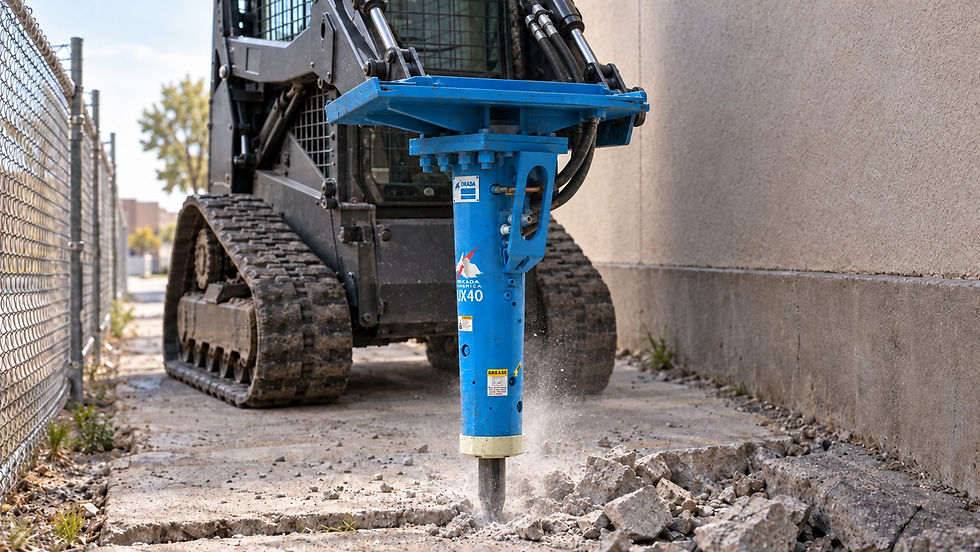
Every UX breaker ships with a mounting bracket made to suit your carrier. Choose an excavator-type bracket for pin-on or coupler mini-excavators, or a backing plate for skid steers and compact track loaders. Same uni-body breaker, configured for the machine you run.
Backed by nearly 50 years of OKADA breakers
The UX Series is the newest chapter in a long line: UB (1977), OKB (1987), TOP (2000), ORV (2011), and now UX (2026). OKADA America has supplied hydraulic attachments to North American dealers and contractors since 1995, with branches in Oregon, Ohio, and Texas and more than 200 U.S. and Canadian distributors, so parts and support stay close to the job.
Frequently Asked Questions
What is a uni-body hydraulic breaker?
A uni-body hydraulic breaker has its cylinder and front cap integrated into one body. There are no side rods, no separate housing, and no buffers, which are the parts that most often loosen or wear on a conventional breaker.
Is a uni-body breaker lighter than a conventional breaker?
Yes. The OKADA UX Series is about 10% lighter than comparable models, which helps balance and fuel efficiency on compact carriers.
How is maintenance different?
The UX Series has about 36% fewer parts than conventional breakers. The one-piece slip-fit bushing can be replaced in the field without special tools, and piston scoring is fixed by replacing the cylinder liner instead of the cylinder.
Which UX models have Anti-Blank Firing?
ABF is standard on the UX40, UX60, and UX70.
What machines does the UX Series fit?
Mini-excavators, compact utility loaders, skid steers, and compact track loaders from about 1.2 to 9 metric tons.
Find the right UX breaker for your machine
Tell us your carrier make and model, and we'll confirm the right UX model, bracket, and options. Request a quote or a dealer referral, call 330-239-2666, or email info@okadaamerica.com. You can also learn more about OKADA at okadanow.com
OKADA Blue. OKADA Strong.
Comments