


NEW FOR 2026
The UX Series Uni-Body Breaker
Compact. Lightweight. Built to keep working.
OKADA's newest hydraulic breaker replaces the conventional side-rod housing with a single integrated body, cutting weight by roughly 10% and parts count by 36% compared with comparable models. Five models cover carriers from 1.2 to 9 metric tons, so there's a UX for nearly every mini-excavator, skid steer, and compact track loader in your fleet.
NEW FOR 2026
The UX Series Uni-Body Breaker
Compact. Lightweight. Built to keep working.
Okada's newest hydraulic breaker replaces the conventional side-rod housing with a single integrated body, cutting weight by roughly 10% and parts count by 36% compared with comparable models. Five models cover carriers from 1.2 to 9 metric tons, so there's a UX for nearly every mini-excavator, skid steer, and compact track loader in your fleet.

5 Models
UX20 through UX70

225 - 1000 ft-lb
Impact energy class

~10% Lighter
Than comparable models

36% Fewer Parts
Than comparable models
Why uni-body changes the math
Conventional breakers bolt a cylinder, front cap, and housing together with side rods. Every one of those joints is a place to loosen, wear, or fail. The UX Series integrates the cylinder and front cap into one body — no side rods, no housing, no buffers. The result is a breaker that is simpler to own, lighter on the boom, and easier to service in the field.


Engineered for compact carriers
Everything on the UX Series was designed around small excavators and tight job sites — from the balance of the breaker on the boom to how fast a technician can swap a bushing.


Uni-body structure
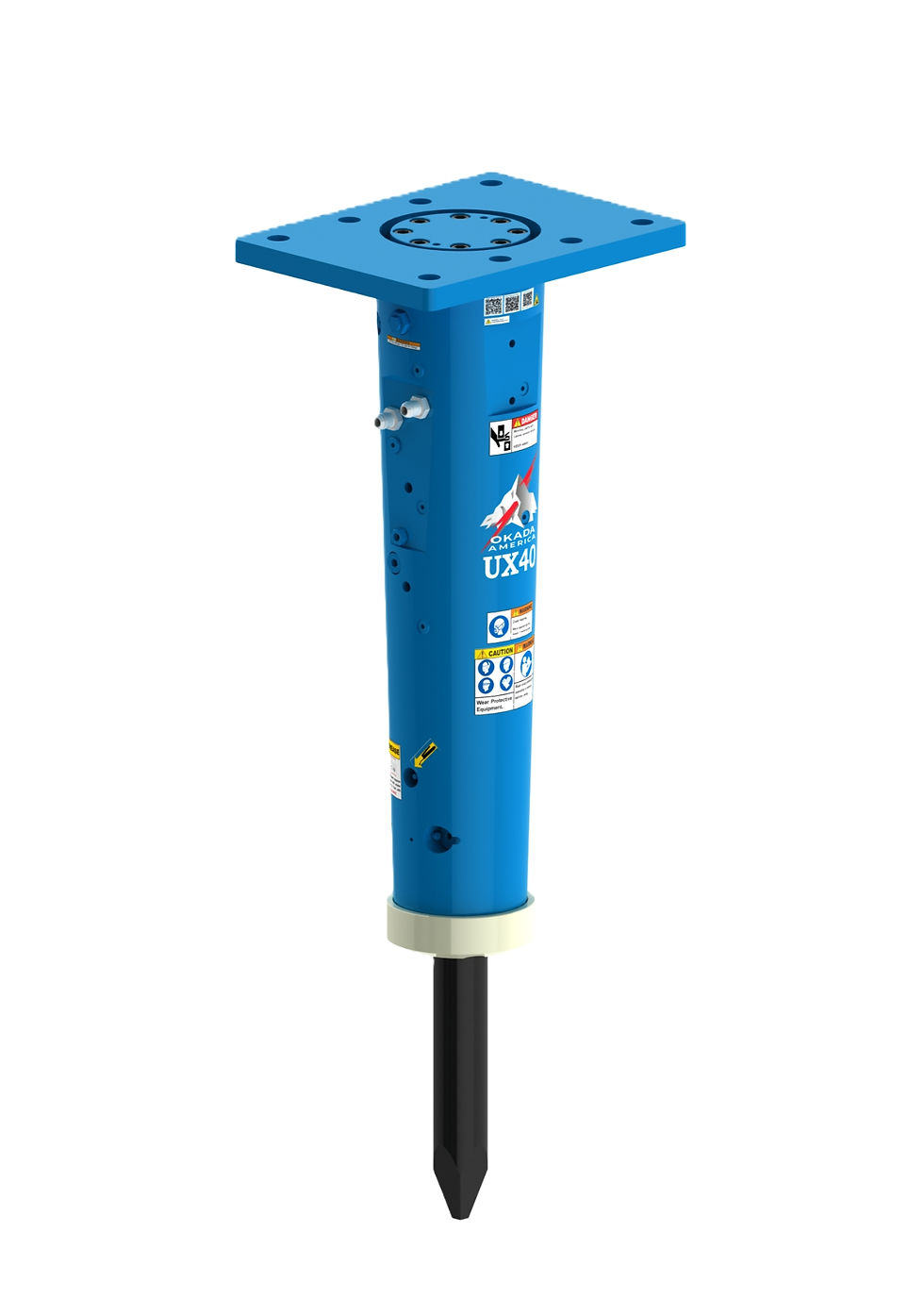
Compact & lightweight

Split-fit tool brushing

Serviceable cylinder liner

Anti-blank firing (ABF)

Hybrid power, internal valve
Five models. One design philosophy.
Match the breaker to the carrier. Operating weight includes the complete breaker assembly with upper mounting bracket. Mounting brackets are made to suit your carrier.
Specification | UX20 | UX30 | UX40 | UX60 | UX70 |
|---|---|---|---|---|---|
Impact energy class (ft-lb) | 225* | 350 | 475 | 750 | 1,000 |
Carrier weight range (lb) | 2,600–6,600 | 5,500–9,900 | 6,600–12,100 | 8,800–15,400 | 13,200–19,800 |
Carrier weight range (metric t) | 1.2–3.0 | 2.5–4.5 | 3.0–5.5 | 4.0–7.0 | 6.0–9.0 |
Operating weight (lb) | 293 | 383 | 471 | 626 | 773 |
Oil flow (gpm) | 5.3–10.6 | 6.6–13.2 | 7.9–15.9 | 10.6–18.5 | 13.2–23.8 |
Operating pressure (psi) | 1,280–1,707 | 1,280–1,707 | 1,422–1,849 | 1,565–1,991 | 1,707–2,134 |
Frequency (bpm) | 700–1,200 | 600–1,100 | 500–1,000 | 500–900 | 400–800 |
Tool diameter (in) | 1.77 | 2.24 | 2.4 | 2.75 | 2.9 |
Anti-Blank Firing | — | — | Standard | Standard | Standard |
Auto-lube & underwater ports | — | — | Standard | Standard | Standard |
Bolt pattern | OKADA 02 | OKADA 02 | 301 | 301 | OKADA 03 |


FAQ
-
Made to fit your carrier
Every UX ships with a mounting bracket built to your machine's pin-on or coupler, in excavator or skid steer / track loader configuration.
-
Parts and service in the U.S.
Stocked and supported from Canby, OR; Joshua, TX; Medina, OH; and Solon, OH.
-
Nearly 50 years of breakers
UB (1977), OKB (1987), TOP (2000), ORV (2011), and now UX (2026). Okada is the market-share leader in demolition attachments in Japan.
Q. What carriers does the UX Series fit?
Mini-excavators, compact utility loaders, skid steers, and compact track loaders from roughly 1.2 to 9 metric tons (2,600 to 19,800 lb). Use the spec table above or send us your machine model and we'll confirm the match.
Q. What does "uni-body" actually mean?
The cylinder and front cap are one integrated piece. There are no side rods (tie rods), no separate housing, and no buffers — the components that most often loosen or wear on a conventional breaker.
Q. How is maintenance different from a conventional breaker?
The one-piece slip-fit bushing is replaced in the field without special tools. If the piston scores, only the cylinder liner is replaced, not the cylinder. Overall parts count is about 36% lower than comparable models.
Q. How do I buy one?
Through your OKADA America dealer. Use the form below to request a quote or a dealer referral, and include your carrier make and model so we can spec the bracket.
About OKADA America
Precision Attachments. Nationwide Support.
What sets OKADA America apart is reach. We are the only company in our industry with three branch locations across the United States — Oregon, Ohio, and Texas — each a stocked warehouse and service center. Through these branches and more than 200 U.S. and Canadian distributors, parts, reconditioned units, and factory-trained support are never more than one time zone away.
1938
OKADA Aiyon founded, Osaka
1995
OKADA America established
200+
U.S. & Canadian distributors
3
U.S. branch locations — the only ones in our industry

OKADA America has supplied hydraulic attachments to North American dealers and contractors since 1995 through its parent company, OKADA Aiyon of Osaka, Japan. OKADA Aiyon began in 1938 building a single line of breakers and has grown into a global manufacturer of demolition attachments — breakers, crushers, shears, pulverizers, processors, grapples, compactors, and screen buckets. The OKDADA family is still active in daily operations and still demands the precision engineering and stringent quality control that give every attachment its long product life.

Request a quote or a dealer referral
Tell us what you're running and we'll confirm the right UX model, bracket, and options.
Oregon - West
372 S Sequoia Pkwy, Canby, OR 97013
Ohio - Midwest & East
904 Medina Rd, Medina, OH 44256
Texas -South & Central
3575 Windmill Rd. Bldg.#2
Joshua, TX 76058
